Friday, June 6, 2008

Book Portfolio Quarter 4

Hunger by: Sharman Apt Russell


Seeing food sends a message to your nerve cells in the lower brain, which then sends a message to the stomach and pancreas. This starts the production of the enzymes, acids and mucus. The lower brain triggers the salivary glands, making your mouth water, and now your ready to eat.

Saliva stimulates taste receptors, and lubricates food. Your tongue pushes the food back and after that your body takes over.The small intestine does most of the job of absorbing nutrients. Many studies have been performed to come to these conclusions.

" Hunger is experienced not just in abdominal ache but as a heaviness in the limbs, a yearning in the mouth." Says Drew Leder who studies people's eating habits.

In 2001 Angelo Del Parigi, of the national institute of Diabetes and Digestive and Kidney Diseases performed a study. The object was to see if the brains of men and women responded differently to short- term hunger. The subjects ate well balanced and healthy meals for a week and then were not allowed to eat for thirty- six hours. In his experiment men and women did not show any significant differences in how they rated hunger.

Back in 1848 Henry S. Tanner moved to the United States from England. He was taught that human beings could not live for more than ten days with out food. After a few years of living in the U.S Tanner became more and more depressed and decided he would starve himself to death by not eating for ten days. Ten days later he was still in good health. He ended up fasting for forty days and on the 40th day when he could eat he surprised many people. He ate a peach, drank a glass of rice milk, devoured a watermelon, ate a broiled beef steak and a half pound of sirloin. He soon gained back all his weight. He began promoting his idea of the " recuperative power of the self."

Many people stop eating or fast in protest, they are called hunger strikers. They believe hunger can strengthen the weak, inspire the timid and bully the powerful. Fasting as protest is not new. In medieval Ireland fasting against someone was part of their legal system. If someone felt you had done something wrong to them and died hungry on your door step, you became responsible for his debts.

Today we have many people who can not afford food or even clothing. Their are many starving families in Guatemala for instance and this is not something new. Hunger has been around forever, even since we lived in caves and trapped our own food, or picked nuts and berries it is just more known now than ever.

Friday, May 9, 2008

David Brearley

David Brearley was born on June, 11 1745 in Spring Grove, New Jersey. The same state that he represented. In 1776 he took place in the convention that drew up the State Constitution ,and in 1779 he was elected as Chief Justice of New Jersey Supreme Court, where he held the position for ten years until 1789. He was 42 years old when he participated in the Constitutional Convention. Like William Paterson he opposed proportional representation of states in congress. He thought that only a constitutionally based government could guarantee that the nations military forces would remain properly ordered to their elected civilian leaders. Brearley looked for a stronger government that would protect the rights of all states under a rule of law. President Washington appointed him as a federal district judge and he served until his death. Brearley died in Trenton at the age of forty five in 1790 and was buried at St. Michael's Episcopal Church.

David Brearley has enough historical recognition. He really did not play a major role in the revolution. He may have been Chief Justice but this does not really make him stand out. Brearley did little to earn the recognition he has and if he was given more what would it be for. He was not a hero ,nor was he ever president or any such thing. The most he did was look for a stronger government and serve as a judge.

Propoganda Essay

I believe that the colonies have every right to rebel against Britain. They killed people in the Boston Massacre and now they must suffer the consequences. If they had not fired at a group of mostly innocent, some not, people there would not be such an outburst. I believe the colonies should rebel for they have suffered and now the British must suffer too. It was a disgrace to the British for acting in such a manner and the people were only trying to find out what all the commotion was about. If we do this we will see a great future. We will think for ourselves and we will have our own freedom. No one will take our land and our ways away from us.

Tuesday, May 6, 2008

Boston Massacre Essay

During the 1760's the town of Boston was more and more affected by migration, change and maturation. Protests against the Stamp Act had been very bitter, so in 1768 the British government ordered soldiers to got to Boston to restore order and enforce laws. Instead their plan backfired. The soldiers only increased tensions and incidents between the redcoats and Bostonians became common. On February 22, 1770 a British man named Ebenezer Richardson tried to tear down and anti -British sign and was followed to his house by an upset crowd. They teased him and broke his windows with stones, one of which struck his wife. Very angry about what had happened, he grabbed his musket and fired into the crowd. He accidently shot an eleven year old boy who died eight hours later. Richardson was dragged from his house and to jail. Destruction of property and burning of effigies also became common. On August 1765 in Boston, crowds protesting the Stamp Act destroyed the homes of stamp distributors Andrew Oliver and Thomas Hutchinson. On March 5th, 1770 the crowd and the soldiers acted even more unlike themselves. A group of boys were taunting a British Sentry in front of the Custom House. Then one of the soldiers struck a Bostonian with his musket which only made things worse. No one could calm the crowd, so one of the soldiers fired and others followed, leaving five dead and six wounded. This became known as the Boston Massacre.

I find the Bostonians guilty. If they had shown some respect and not gotten so out of hand, none of this would have ever happened. There is no excuse for them to treat the British soldiers, who were trying to help, the way they did. If you were being disrespected and taunted in such a manner, what would you have done? If your wife was hurt or you were being surrounded, with no escape, by an angry mob, what would you resort to? I feel that the British were only doing what needed to be done for their own safety.

I do not think that the British should go unpunished but neither should the Bostonians. It is not for me to decide how they get punished but they both need to learn how to act in a mature and respectful manner. As for the Bostonians, their actions were unacceptable and if they had not acted in such a way none of this would have happened.

Monday, March 17, 2008

Qtr. 3 Book Portfolio

If I Should Die Before I Wake, by Han Nolan is about a girl named Hilary who gets into a motorcycle accident and is put in the hospital. She dreams that her name is Chana and she is a jew. Her whole time is at the hospital as she drifts in and out of consiousnous she lives in another world.


She is sent to a concentration camp and stripped down to nothing. (http://www.ushmm.org/wlc/article.php?lang=en&ModuleId=10005144) People today can still remember this moment in their life like Henny Fletcher Aronson who was one of the many victims of the Nazi concentration camps.


"As we came to Stutthof, they told the women to get out, and they said we will meet, we'll meet up with your, uh, husbands and fathers later on. So my sister-in-law, the two of us got off the train, and, uh, I think, you know, I'm not sure if they had transportation. Yes, they had, I think, open, open trucks where we were, uh, piled in, and we were brought to Stutthof. And then we were told, of course, right away my coat was taken away, and whatever else I had, which was very little, I suppose, because, uh, I didn't have a chance to take anything with me. And I held on to my mother, and then they told us to disrobe. Uh, you know, they had always tables and young Germans sitting behind it. And they said to us, "Okay, go in in this large area and disrobe." I mean by disrobe take everything off. So here I am next to my mother, hundreds of women, and we had to be totally naked coming in in front of a desk with a bunch of young hoodlums. So what do you think in a case like that? They are creatures from some other planet. There was no planet then, but creatures from hell. Why should I bother worrying about them, what they look at me. Because how demeaning can you even feel with standing your mother and relatives and friends, I mean I didn't have relatives, my, my sister-in-law. And here you are standing totally naked, and they look at you, it's like.... So, uh, I just stood there, and they just looked at us, and then they told us to go in the back to take showers, and they gave us the uniforms, the striped uniforms, and this is how our ordeal started. And this is concentration camp."


After being hosed down, shaved and given raggy clothes to wear Chana was sent out into the freezing winter air along with the others. Days passed and everyone is starving. The prisoners are continually pushed to their limits, some people drop dead right where they are working and are just left there. Chana stays strong knowing her grandmother is their to support her. Day after day the jobs get harder and less food is given out. Many jews were beat and some were burnt alive. They were treated like wild animals and not like human beings. One women remembers that time in her life all too well.


"I have seen a lot of dead people around, all over, and I guess when you see so many, it doesn't really make that much of an impression. One of the times in Ostrowiec Lager [camp] I was in the, uh, outhouse, in the bathroom, which was on the corner of the, uh, uh, area where like it was a big area in the center of the camp, and then all the barracks were around it, mostly actually on two sides, and the outhouse was at the corner. And I happened to have gone into the outhouse and, uh, all at once there is a commotion and everybody is rushed into their barracks, because that's where they were supposed to go, and, uh, I got stuck in the bathroom. Well, I got up on the seat and I looked out of the little window on the top, and what had happened is some people tried to escape, and they were caught. And I guess they were wounded, and there was some shooting going on, and they got about, I think, four people to dig graves just outside of the wire of the fence of the camp. And they brought these, uh, people that tried to escape, that were, uh, shot already, but they were not dead. And they made the other Jews bury these people that were not really dead yet, and they were begging not to be buried, that they're still alive, that they should do something to kill them. But they didn't do anything, they just buried them alive. And these people had to do it, or else, these poor people who that were been picked to do it, because otherwise they themselves would have would up in--dead. That was a very, very traumatic experience. I can still hear them screaming."- Ruth Webber.


Eventually Hilary fully recovered and stopped living in Chana's life. She did not come out of it unchanged. She changed her views and opinions on many things completely.


Tuesday, March 11, 2008

Plymouth Essay

The founding of English colonies in modern Massachusetts combined a strange mix of idealism and violence. Miles Standish contributed important protection to the early colonies by using violence. Benjamin Church provided vital leadership to protect the colonies during King Philip's War. Despite all of this violence, the colonies were also founded on religious idealism. It is important to understand the full history of these areas because this is what Americans generally consider to be our nation's beginning.


Miles Standish contributed important protection to the early colonies by using violence.
In the middle of night he breaks into a wigwam looking for Corbitant. He had people with him with guns and women and children were very scared. It was very chaotic. Secondly Miles invites people to dinner with him and stabs the guy for not having the same beliefs. A guy who traded with the indians more than pilgrims Miles forced to leave. Standish used violence in all his encounters with people who were not helping out the pilgrims.


Benjamin Church provided vital leadership to protect the colonies during King Philip's War. He got together a group of men and went after the indians. Tried to use the indians tactics against them. They were outnumbered and had to leave in a canoe. Church and his soldiers were ambushed in the middle of the night and King Philip was killed. Church led his men to the indians shelter where they said a few words in honor of King Philip. Church was expected to hunt down two notoriuos warriors and he captured some indians and brought them to Plymouth. Benjamin Church provided leadership for his men and in the end he captured and killed many indians which is what he set out to do.


Despite all of this violence, the colonies were also founded on religious idealism. The pilgrims did not want to kill the indians they just wanted to create a community where everyone had the same religion and beliefs. The pilgrims celebrated Thanksgiving as new colonists arrived because most of them were puritans. They ended up living in peace with the Wampanoags until 1664 . Puritans like the pilgrims were religous people and they celebrated their religous freedom.


The founding of english colonies in Massachussets combined violence and religion to create a community. Miles Standish used violence to protect the colonies. Benjamin Church used leadership to take over the indians. The colonies were founded on religion. There was a constant battle between the pilgrims and the indians and many men helped to make the pilgrim community the best one as possible. Everything was based on religion and in order to keep the religion the same they had to use violence.

Plymouth Essay outline


I. Introduction


A. The founding of English colonies in modern Massachusetts combined a strange mix of idealism and violence.


B. Preview first major point (without support) [Miles Standish contributed important protection to the early colonies by using violence.]


C. Preview second major point (without support) [ Benjamin Church provided vital leadership to protect the colonies during King Philip's War.]


D. Preview third major point (without support) [Despite all of this violence, the colonies were also founded on religious idealism.]


E. Significance of Thesis [It is important to understand the full history of these areas because this is what Americans generally consider to be our nation's beginning.]


II. First Major Point


A. Miles Standish contributed important protection to the early colonies by using violence.


B. In the middle of night he breaks into a wigwam looking for Corbitant. He had people with him with guns and womenand children were very scared. chaotic.


C. Miles invites people to dinner with him and stabs him.


D. A guy who traded with the indians more than pilgrims Miles forced to leave.


E. Standish used violence in all his encounters with people who were not helping out the pilgrims.


III. Second Major Point


A. Benjamin Church provided vital leadership to protect the colonies during King Philip's War.


B. He got together a group of men and went after the indians. Tried to use the indians tactics against them. They were outnumbered and had to leave in a canoe.


C. Church and his soldiers were ambushed in the middle of the night and King Philip was killed. Church led his men to the indians shelter where they said a few words in honor of King Philip.


D. Church was expected to hunt down two notoriuos warriors and he captured some indians and brought them to Plymouth.


E. Benjamin Church provided leadership for his men and in the end he captured and killed many indians which is what he set out to do.


IV. Third Major Point


A. Despite all of this violence, the colonies were also founded on religious idealism.


B. The pilgrims did not want to kill the indians they just wanted to create a community where everyone had the same religion and beliefs.


C. The pilgrims celebrated Thanksgiving as new colonists arrived because most of them were puritans.


D. They ended up living in peace with the Wampanoags until 1664 .


E. Puritans like the pilgrims were religous people and they celebrated their religous freedom.


V. Conclusion


A. The founding of english colonies in Massachussets combined violence and religion to create a community.


B. Miles Standish used violence to protect the colonies.


C. Benjamin Church used leadership to take over the indians.

D. The colonies were founded on religion.


E. There was a constant battle between the pilgrims and the indians and many men helped to make the pilgrim community the best one as possible. Everything was based on religion and in order to keep the religion the same they had to use violence.

Monday, February 11, 2008

John Smith Quotes


They are gentle, loving, faithful, lacking in all guile and trickery. The words denoting lying, deceit, greed, envy, slander, and forgiveness have never been heard. They have no jealousy, no sense of possession.--John Smith (character)


We shall make a new start. A fresh beginning. Here the blessings of the earth are bestowed upon all. None need grow poor. Here there is good ground for all, and no cost but one's labor. We shall build a true common wealth, hard work and self reliance our virtues. We shall have no landlords to rack us with high rents or extort the fruit of our labor. --John Smith

Wednesday, January 30, 2008

Wounded Knee Essay

Wounded Knee illustrates one of the final events in a long series of violent conflicts motivated by racism, disrespect and lack of understanding. One source that I used was a trip to the monument on YouTube. It showed how extreme some people will go just to be disrespectful. Another source I used was a YouTube video documentary of stories of Wounded Knee that were told by the survivors families. I also used NokomisHistory.com for the Wounded Knee paragraph. The soldiers were abusive to the men during disarming and the women and children were separated. It really shows how the indians were treated inkind and unfair.
Wounded Knee was the last event of many that were caused by racism. Feces were left in a take out container at the Wounded Knee monument which is very disrespectful. Families of the survivors still are suffering because they know what their anscestors were put through. Before taking capture of the Indians and taking all their weapons the soldiers got drunk and made fun of them. All of these actions were triggered by racism and are degrading.
Wounded Knee was a fight for land between the Indians and the 7th calvary. Wounded Knee was a battle that showed the horrible way the indians were treated. It was the last of many battles but it certainly was not inimportant.

Monday, January 28, 2008

Wounded Knee Outline

I. Introduction

A. Wounded Knee illustrates one of the final events in a long series of violent conflicts motivated by racism, disrespect and lack of understanding.
B. Utube Trip to Monument. Showed the monument had been disrespected because someone left feces near the monument.
C. Utube video documentary. Stories of Wounded Knee told by the survivors families.
D. Nokomishistory.com Wounded Knee paragraph. Soldiers were abusive to indian men during disarming and women and children were seperated.
E. It really shows how the indians were treated unkind and unfair.


II. Body of Essay

A. Wounded Knee was the last event of many that were caused by racism.
B. Feces were left near the monument.
C. Families of the survivors are still suffering because of this.
D. The soldiers got drunk before taking capture of the indians and then took away all of their weapons and dignity.
E. All of these actions were triggered by racism and were all very disrespectful and degrading.


III. Conclusion
A. Wounded Knee was a fight for land between the Indians and the 7th calvary.
B. Some people are still disrespectful.Monument.
C. Native Americans still don't get enough respect for what their anscestors went through.
Wounded Knee may have been the last of many battles with the indians but it certainly was not unimportant and brutal.

Tuesday, January 15, 2008

Mid Term Essay

Hitler and the Nazi's came into power by tricking the people. They made people think they were good and trying to help when really they were only trying to help themselves. Many people died because of the way they were treated in the concentration camps. People would lie dead on the streets and no one would even move them or give them a proper burial.
Jews were told that they were being taken to a safe place where they would be well taken care of and would be able to get away from the hectic and fearful lifestyle of the war. He promised them clean homes and plenty of food but that is far from what they got. People were sleeping with many other people in the same room and there definitely weren't enough beds. There was not enough food to go around so some people went without. People wore old rags and lived on the streets. There was no doctor that took care of the people so illness would spread and take over quickly. People would lie in the streets next to the dead but no one had the strength to move them. People were very unclean and it is impossible to imagine how horrible they were treated.

Book Portfolio 2

Danielle Sylvester

Of Mice and Men
Things don’t always work out as planned. In the historical fiction book, Of Mice and Men by John Steinbeck he shows that you can’t let people hold you back from your dreams, even if they are supposed to be a part of it. If no one goes after their dreams what would the world be. If Martin Luther King did not have a dream and stand up for what he believed in then we would not be as accepting of other races.http://en.wikipedia.org/wiki/Martin_Luther_King,_Jr. George and Lennie have a dream that they will have their own ranch someday and will be able to live off the land, George has to take care of Lennie who is mentally challenged and doesn’t realize his own strength. Lennie accidentally killed his puppy by being to rough and then he killed Curley’s wife. He didn’t mean any harm but he doesn’t realize the consequences of his actions. Curley goes after him and wants to kill him or maybe even do something worse but George finds Lennie and makes him think about their dream ranch and shoots him. He knew he had to do it for Lennie, it hurt and it was hard but if they found Lennie George would have gotten into a lot of trouble too.
Lennie and George travel together. Most men find that strange but it is normal for them. Lennie is mentally challenged and is a rugged guy. He is tall and he tends to forget a lot. He is a nice guy and would never want to harm anyone or anything. He forgets his own strength when he is talking to Curley’s wife and ends up killing her. George is the one who is there for Lennie he is an average size guy and is very clever. He tells Lennie that if he ever gets into trouble to hide in the brush and wait for him to get there. When Lennie gets in trouble George finds him and knows what he has to do, even though it is hurting him inside to do this to his friend. He kills Lennie for his own good and also if he didn’t he probably would have been killed too. In history people didn’t have the chance to stand up for themselves. There were no rights for women and they were not aloud to stand up for themselves but thanks to one person things have changed.
I agree with the theme because if you let people stand in the way of your dreams then what are you living for. When I was younger I wanted to be a horse back rider so I got a job at a farm and took lessons and eventually I went to shows. If I had let anyone get in my way I would not have found a hobby that I really enjoy. I am sure that everyone has had a dream at some point in their life, like maybe to go to college or get a job. That is why we all got to school, so that we can chase after our dreams. If everyone gave up on their dreams then we would not be as free as we are today. Many people in history stood up for what they believed in and it is helping to make a difference for us today.
Steinbeck’s purpose for writing this book is to persuade us into following our dreams. The characters were believable because there were people who tried to get in the way of George and Lennie’s dream just like there are people in the real world who will try to take your dreams away from you and also like Martin Luther King who had many people standing in the way of his dream. The American dream theme is believable because everyone has a dream and everyone can make it come true with a little courage and effort. Things get tough but you have to do what you have to do. In Of Mice and Men by John Steinbeck he shows us to follow our dreams.

Thursday, December 13, 2007

Exam #4 part1 prompt 1

The Russian and the French revolution happened because of poor leaders and poor economy.

Exam #4 part2 prompt 2

-"Pablo Picasso's Guernica is a work of art and not propoganda." I disagree with this statement. Propaganda is when a picture symbolizes something and that is all that is needed to get the point across. In my mind Guernica symbolizes the terrible destruction in the bombing. It also symbolizes the suffering and hardship that the town faced.
- Guernica shows many faces that look distressed and it also shows many different body parts all jumbled together. I think this symbolizes all the lives that were taken and all the innocent people who had to suffer because of something they did not know was coming.
- The picture also shows smoke coming out of blackness in one of the corners. This relates to what the town would have looked like when it was bombed. It was empty, filled with nothingness and blackness, smoke rising from the devastated town. Pablo Picasso's Geurnica is a work of art and propoganda.

Friday, November 16, 2007

Stalingrad Questions

1. What does Joseph Stalin's advice to the people of Stalingrad say about him as a leader?
*** It says that he is a strong leader but that he does not care about the lives of the people. He just wants to win and take care of himself.


2. Explain why Hitler would react in the way shown after signing a Non-Aggression Pact with Stalin?
*** Hitler would do that because he knew he had them believing that there was going to be no fighting. He would attack and be prepared but Stalin would not be prepared. Hitler would be able to defeat them.


3. Explain the significance of propaganda in this battle, using examples from the posters.
*** Propaganda showed how much hitler was hated. It shows many pictures of things that represented the nazis being stapped or harmed.

4. What do the extremes of the war reveal about what it takes to win a total war?
*** It takes a lot to win a total war. It takes seeing people die and losing loved ones. It takes being hungry and lonely but pushing yourself to fight. It takes strength, motivation and determination.

5. How does the story of Vasily Zaitsev relate to the war in Iraq?
*** The German side had all kinds of military equipment and the Russian side didn't. In Iraq the U.S has all kinds of military equipment and Iraq doesn't have has high tech equipment.

6. In times of crisis, sometimes heroic figures emerge. Which figure emerged in a similar way to Vasily after the terrorist attacks of 9/11?
*** The firemen because they went into Iraq and helped out people who were in need of it.

Tuesday, October 23, 2007

Book Portfolio- Fast Food Nation

Fast food relies on unsafe and unhealthy working conditions to make a profit. J.R Simplot is the main supplier of french fries to McDonalds. He sells them for thirty cents a pound and in turn McDonalds sells them for six dollars a pound. This is a big improvement compared to making their own fries, it is less time consuming to buy frozen fries than it is to make homemade french fries.


McDonalds also gets their meat from meat packing plants. Workers in the meat factories are mostly latino women. They are in a cramped space and they trim the fat off the meat and slice it in a matter of seconds. One of the most dangerous jobs in the meatpacking industry is cleaning up. The clean up crew is made up of mostly illegal immigrants and they are paid one third less than regular employees. They use a high powered hose that shoots out a water and chlorine mixture that is heated up to about one hundred eighty degrees. The plant fills with a fog and it gets hard to see even five feet in front of you. They clean out grease, fat, manure and leftover meat scraps. The plant can get as hot as one hundred degrees when being cleaned. This shows how dangerous the job was. It is like the industrial revolution. Women had dangerous jobs and were not paid nearly enough.

The working conditions are very poor. There is very many accounts of people being injured. One person lost two fingers in one of the machines and his supervisor told him that, "If one hand is no good, use the other." At the Dakota City Plant the injury rate was one third higher than the average. The plant did not report serious injuries like fractures, concussions, major cuts, hernias and some that required surgery, hospitalization and even amputation.

One worker reached into a machine to remove a piece of meat. The machine turned on and his arm got stuck. He was rushed to the hospital and his shoulder was sewn up. After he got stitches and a prescription , he returned to the slaughterhouse and was put back on the production line. Another worker named Kenney tried to catch a ninety pund box and was knocked off balance. He fell against the conveyor belt and the metal rim pierced his lower back. The company doctor bandaged him up and said it was just a pulled muscle. He stayed home for a couple of days and then returned to work. He later saw another doctor and was told that he had a pair of severely herniated disks. He had to have back surgery and spent a month in the hospital. He was having financial diffuculties and returned to the slaughterhouse.

One time Kenney was asked to disinfect the plant because of Salmonella contamination. He had to spray a liquid chlorine mix, which to spray he needed safety goggles, protective gloves, a self contained respirator and full coveralls. All he was given was a paper dust mask. He went home and became ill. He was rushed to the hospital and put in an oxygen tent. His lungs had been burned and his body was covered in blisters from the chemicals. He eventually recovered and went back to work. He later broke his leg stepping into a hole at the slaughterhouse and was then given a job carrying bags of knives up steep flights of stairs for recycling. Kenney had a heart attack while trying to loft heavy boxes one day and while recuperating was fired.
" They used me to the point where I had no body parts left to give," said Kenney."Then they just tossed me in the trashcan." This quote shows how unfair it was in the meatpacking industry, but do you think McDonald's cared about those people? Probably not. It was cheap labor and McDonald's made a profit so they couldn't complain about what went on outside of their restaurants. They were making a profit from those peoples unhealthy and unsafe working conditions.

Thursday, October 18, 2007

The Columbian Exchange transformed the world in a more radical (drastic) way than any other development in world history. One significant effect of this process(advance) was the establishment of the Triangle Trade. While many factors were a part of the Triangle Trade, the rapid growth in both supply and demand for new commodities was the largest motivating element. This time period may be best associated(linked) with economic developments, but it is impossible to analyze(consider) this period without considering the intense social impact that the Triangle Trade had on those involved. In truth, a full understanding can only be gained by appreciating(understanding) how economic and social factors(happenings) impact each other in history.


The Columbian Exchange which is the exchange of goods from Europe and America, changed the world in a drastic way. One effect of this advance was the beginning of the Triangle Trade. The triangle trade was a route that was taken to get slaves. The quick growth in supply and demand for new commodities was the biggest moving element. This time period could be best linked with economic advancement, but it is impossible to consider this period without bringing into thought the huge social impact that the triangle trade had on the people involved in it. You have to understand how economic and social happenings impact each other in history to understand everything.

Monday, October 1, 2007

Ashlee Davis and Danielle Sylvester


The British Parliament got rid of the transatlantic slave trade in 1807, which increased planters costs when the price of sugar was already dropping. About two thirds of slaves shipped across the Atlantic ended up in sugar colonies.

In Jamaica in 1832 each plantation had about sixty slaves. The sugar plantations were some of the most profitable and some of the largest. Twenty years after the battle of Trafalgar, Jamaican planters began to complain about poverty. There was little sanitation in Jamaican towns , houses were over- crowded, the yards and streets were neglected. Thirty-two thousand people died from cholera because of unclean water.

In 1852 small pox also killed many people. To receive medical treatment the slave had to work on the plantation. Many diseases , like Cholera, malaria and influenza struck the slaves, especially in the summer months.

The abolition of slave trade brought changes in the treatment of slaves. It was no longer worth it to work a slave beyond their limits. Some slaves acquired money which meant they could buy themselves out of slavery, or bought the freedom of their children.
" Encyclopædia Britannica. 2007. Encyclopædia Britannica Online. 25 Sept. 2007 <http://www.britannica.com/eb/article-24158>.

“Jamaica." Encyclopædia Britannica. 2007. Encyclopædia Britannica Online. 25 Sept. 2007 <http://www.britannica.com/eb/article-214970>.

"Cuba." Encyclopædia Britannica. 2007. Encyclopædia Britannica Online. 1 Oct. 2007 <http://www.britannica.com/eb/article-233438>.

Thursday, September 27, 2007


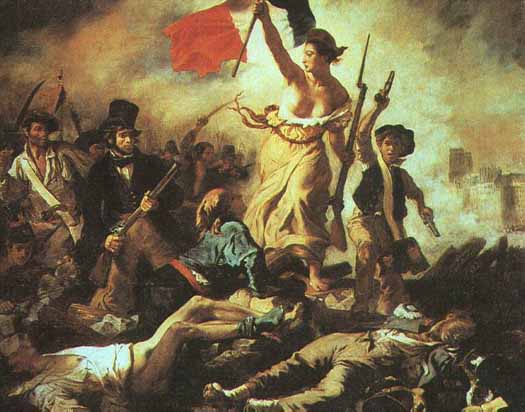
This image shows a women leading a group of men, she is also walking across many men who are laying down. This image shows how women started to have rights and power. It also shows how many people lost their lives in battle during the French Revolution.


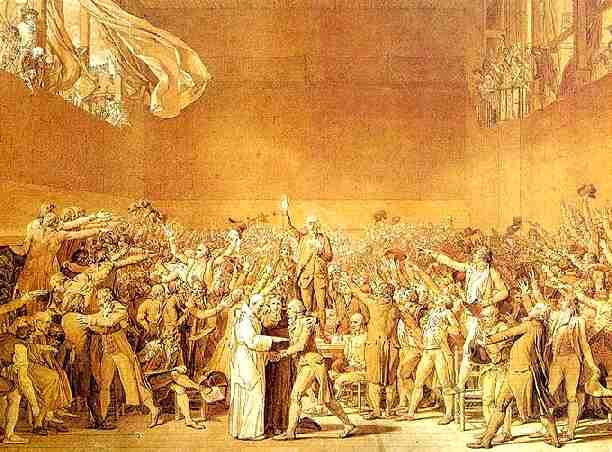
This shows the tennis court oath. It shows many people in a meeting and no one is fighting, everyone is being civilized. This picture shows the beginning of government that is not run by a king or a queen but instead run by the people.


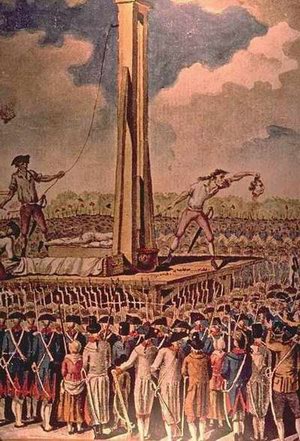
This is a picture of the guitine and all the people who would come watch someone be executed. It is of the man who pulled the rope and a man holding an executed head. This shows the power that many people had and it also shows that people did not have many rights, they just had to do as they were told or else.


Friday, September 21, 2007


This is probably later on in the industrial revolution because it is a big building and their is smog coming from the chimneys. That tells me that the things inside are run by coal or something more advanced.